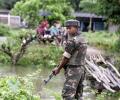
'Our boys are very patriotic.' 'They say Bharat Mata Ki Jai and Jai Hind in front of the Chinese.' 'We have never accepted their claims, we are Indians and proud to be Indians.'

Modi also said the people of India felt proud that President Xi has twice received him out of the capital.

Naravane is scheduled to meet Prime Minister K P Sharma Oli on Friday.

Gen Naravane on Tuesday said he was eagerly looking forward to the visit and exuded confidence that it will go a long way in strengthening the "bonds of friendship" between the armies of the two countries.

It is important the SCO focus strongly on economic development and regional integration that leads to greater benefits for the least developed regions of member-countries, writes Sana Hashmi.

'Chinese government, people and the military were angry over India's dangerous move in Doklam'
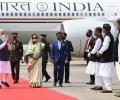
The South Asian nations could script a new history of cooperation and prosperity that could serve as an example for other nations, notes Dr Rahul Mishra.

Replying to clarifications sought by MPs in Rajya Sabha on his statement on the border row, the minister said skirmishes and face-off with China in the last few months have been primarily over the issue of patrolling the Ladakh border.

"Bangladesh does want war," home minister Asaduzzaman Khan Kamal told reporters in Dhaka when asked for comments on the Myanmar security forces actions on the borders, frightening both Bangladeshis and Rohingyas who took refuge in makeshift camps in the neighbourhood.

Chinese President Xi Jinping arrived in Chennai to a grand welcome on Friday, a visit that comes soon after the recent episode of turbulence in bilateral ties over India's decision to withdraw Jammu and Kashmir's special status and reorganise the state into two union territories.

India should watch the emergence of the situation and then see how others react, he said adding that Russia has stood by India in very difficult times.
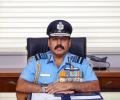
Air Chief Marshal Bhadauria was at the Leh IAF base on Wednesday where he reviewed operational preparedness of the force in effectively guarding the sensitive border areas in eastern Ladakh where Indian and Chinese armies have been on a nearly six-week standoff.

In spite of irritants and hiccups in the relationship, a few deliverables are expected of the prime minister's visit to China, says Rup Narayan Das.
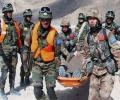
This is the first such incident along the border with China that Indian armed forces personnel have been killed after a gap of nearly 45 years.
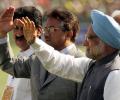
Manmohan Singh and Musharraf felt that what they were embarking upon, if successful, could lead to a future of boundless potential for the two countries and for the relationship that was hard to foresee from the prism of the existing situation and the historical position and orthodox ideas on both sides.

Chinese President Xi Jinping arrived in Ahmedabad on Wednesday to a grand welcome. He is India on a three-day visit which will focus on significantly ramping up trade and investment, besides addressing the contentious border issue that has seen occasional flare ups between the two Asian giants.
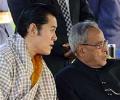
This quiet assertion of China has allowed various smaller countries of South Asia to play China off against India. Most states in the region now use the China card to balance against the predominance of India. Forced to exist between their two giant neighbours, the smaller states have responded with a careful balancing act, says Harsh V Pant.

China remains a "formidable challenge" that has increased its presence not only along India's land borders but also in the maritime domain, Navy Chief Admiral R Hari Kumar said on Tuesday and asserted that the naval force keeps a regular watch in the Indian Ocean Region.


Chinese President Xi Jinping arrived in Ahmedabad on Wednesday on a three-day visit, which is expected to define the relationship between the two neighbours who have had a troubled past.
India on Thursday downplayed the issue of building of a dam by China on Brahmaputra River saying the construction site is 1,100 km away from the country's boundary.

President Xi said that the Chinese side is ready to work with the Indian side to carry forward the fresh impetus of bilateral relations.

Speaking at the Rashtriya Swayamsevak Sangh's Dussehra rally in Nagpur, Bhagwat said community-based population imbalance is an important subject and should not be ignored.
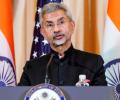
Ties between India and Pakistan nosedived after a terror attack on the Pathankot Air Force base in 2016 by terror groups based in the neighbouring country. Subsequent attacks, including one on Indian Army camp in Uri, further deteriorated the relationship.

Five villagers from Nacho area of the district, who went for hunting in a jungle were allegedly kidnapped by the PLA.
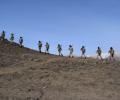
Indian military sources said no firearms were used in the clashes and that most of the injuries were sustained following stone-pelting and use of rods by the Chinese side.
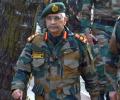
Gen Naravane reviewed the overall security situation in the region with Northern Army Commander Lt Gen Yogesh Kumar Joshi, commander of the 14 Corps Lt Gen Harinder Singh and other senior Army officials.
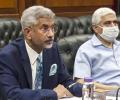
'Terrorism continues to be the overwhelming threat to security and stability in the SCO region and therefore Dr Jaishankar strongly pitched for 'collective action',' observes Dr Rajaram Panda.
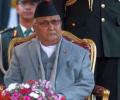
'The redrawing of the map with the inclusion of Kalapani area by Nepal and endorsement from the House of Representatives shows the KP Oli government's move to gain cheap popularity in the name of nationalism'

Prime Minister Narendra Modi on Tuesday left for home after wrapping up his six-day tour that took him to China, Mongolia and South Korea.

Gen Naravane's visit to Nepal from November 4-6 is largely aimed at resetting bilateral ties that came under severe strain following a bitter border row between the two countries.

Indian Army chief General Manoj Mukund Naravane on Tuesday said that as far as the western front was concerned, there is an increase in the concentration of terrorists in various launch pads and there have been repeated attempts of infiltration across the Line of Control.
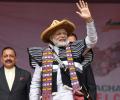
Modi's second visit to Arunachal Pradesh was vehemently opposed by China which urged India to refrain from taking any action that may "complicate" the boundary question.
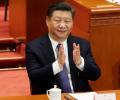
Xi ordered the military to think about worst-case scenarios, scale up training and battle preparedness, promptly and effectively deal with all sorts of complex situations and resolutely safeguard national sovereignty, security and development interests, state-run Xinhua news agency reported, without mentioning any specific issues that posed a threat to the country.
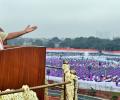
He made a reference to the clash between Indian and Chinese troops in Ladakh's Galwan Valley in June this year. "What our jawans can do, what the country can do, the world has seen in Ladakh," he said.

Once again an Indian prime minister has realised that with Pakistan and China, things will not move as he wishes.
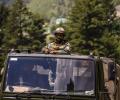
'Our biggest advantage is that the troops are much better trained and motivated than the Chinese and can improvise and manage with a part of the resources.'
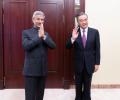
'It is advisable for Indian interlocutors to follow the Chinese tactic of repeating the Indian position, both for the record and to test the Chinese negotiator's resolve and intentions.' A riveting excerpt from former foreign secretary Vijay Gokhale's The Long Game: How the Chinese Negotiate With India.

He stressed the need for strengthening mutual trust and confidence while seeking solutions to outstanding issues.

The Chief of the Army Staff interacted with almost all the injured soldiers and complimented them for their bravery.
